Just talk to us normally assists educational leaders in critically examining their instructional supports, reflecting on how to use these supports to elevate students.
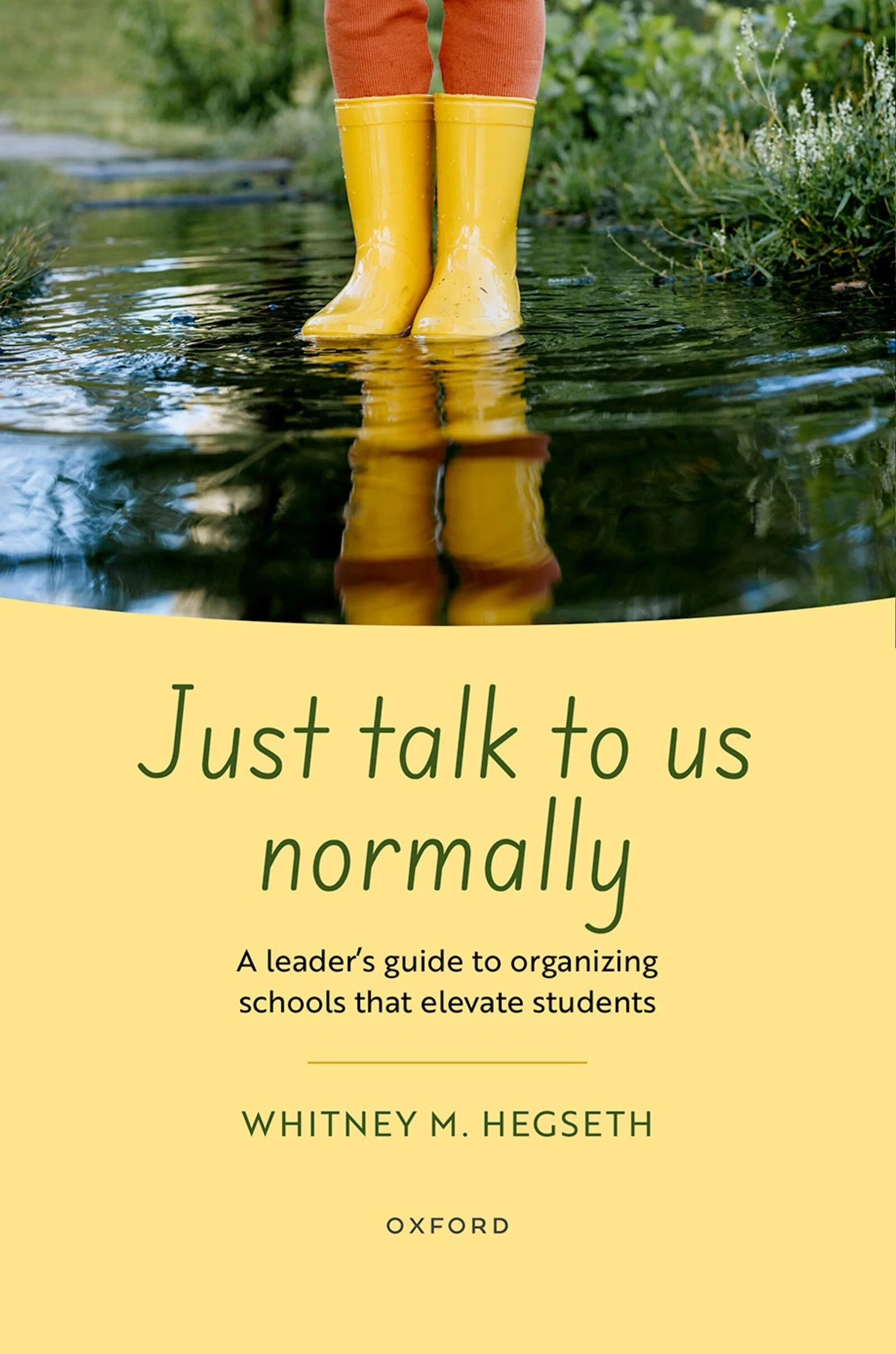
This leadership guide is informed by Hegseth's extensive ethnographic and comparative research in elementary schools that span different educational systems and national contexts. Focusing on the International Baccalaureate and Montessori educational systems, in particular, Hegseth demonstrates how educational leaders can change culture. Specifically, Hegseth argues that educational leaders can use educational infrastructure, both direct and indirect supports to teaching and learning, to improve the way we see and teach young people.
To support leaders in this work, Just talk to us normally provides a framework that highlights the following: there is more than one way to change culture, more than one way for leaders to use educational infrastructure to systemically improve how students are perceived and taught. Educational leaders can determine how adaptable, aligned, and specified their supports are for teaching and learning. However, these decisions leaders make around their educational infrastructure have implications for the work and challenges of leaders, the beliefs and practice of teachers, and the experiences and beliefs of children. The cases and framework presented in this book therefore provide leaders with the tools necessary for enhancing the student experience.
Press Coverage
WRITERS LIFE MAGAZINE | Rethinking Education: An Interview with Dr. Whitney Hegseth, Author of Just Talk to Us Normally
BUILDERS OF A BETTER WORLD PODCAST | Airing soon.
LEARNING FROM LEADERS PODCAST | Airing soon.
NBC 8 TAMPA BAY/BLOOM TV | Tune in for the interview on Wednesday, September 30th at 10:10am.
THE PRODUCTIVE JOY PODCAST | Airing on October 13th
THE MIKE WAGNER SHOW | Tune in for the interview on Tuesday, October 20th at 8:00am.
KNX NEWS 1070 AM - SOUTHERN CALIFORNIA | Audio recording coming soon.

Other ways to purchase Just talk to us normally:
Who This Book is For and Why It Matters
Educational leaders operate in a peculiar space. They inherit systems designed decades ago, yet they're asked to prepare children for a world that doesn't yet exist. They work within bureaucratic structures while nurturing human development. They manage compliance requirements while fostering creativity. This book is for those leaders who refuse to accept that these tensions are insurmountable.
If you're a superintendent trying to scale authentic learning experiences across diverse school communities, this book is for you. If you're a principal watching your teachers struggle to see beyond deficit narratives about their students, this book is for you. If you're a teacher leader wondering how classroom-level innovations can survive contact with system-level realities, this book is for you. If you're a policymaker seeking evidence that educational transformation is possible at scale, this book is for you.
This is not another book that asks you to choose between competing educational philosophies or adopt someone else's model wholesale. Instead, it offers something more valuable: a framework for understanding how educational infrastructure can be leveraged to change culture itself. Through deep ethnographic work in International Baccalaureate and Montessori schools—two systems that have managed to preserve their distinct approaches while scaling globally—we see how ideology can move through tradition to become common sense.
The children in these pages matter because they represent what's possible when educational systems align around a coherent vision of human capacity. This book matters because it demonstrates that educational leaders can be agents of cultural transformation, not just implementers of policy. It provides a practical framework to examine adaptability, alignment, and specificity within educational infrastructure, while maintaining focus on the ultimate goal: changing how we teach and treat children.
The stakes could not be higher. The children in your schools today will become tomorrow's educators, policymakers, and citizens. What will they expect from schooling? What will they assume about children's capabilities? How they answer these questions depends, in part, on the cultural experience you create for them now.
This is not a book that promises easy answers or quick fixes. Cultural change is slow, complex work that requires sustained commitment and collaborative effort. But it is possible. And for those ready to engage in this work—whether you lead a classroom, a school, a district, or a system—this book provides both the conceptual framework and the inspiration to begin.
- William Driscoll, Ed.D, Dean of Faculty at Austin Preparatory School